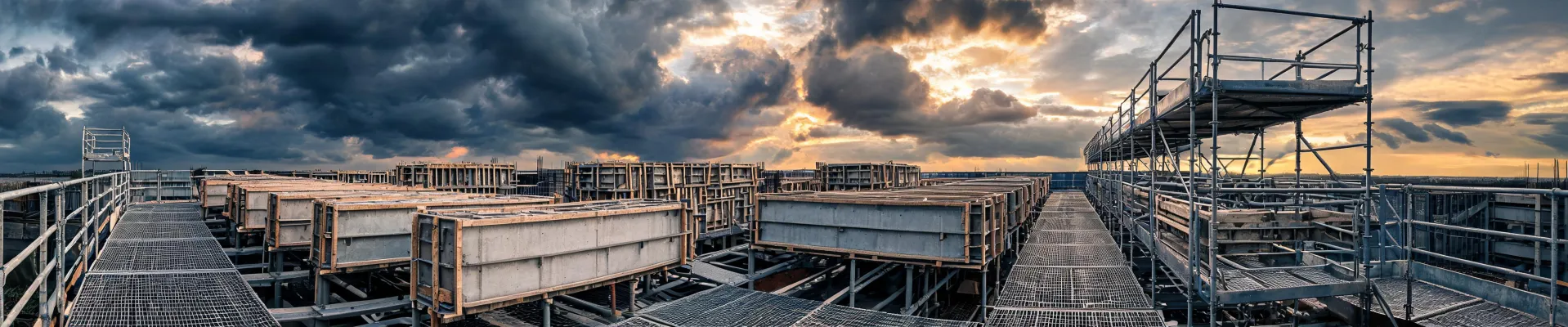
I've been handling procurement for a mid-sized construction firm since 2020. To put that in context: roughly $1.4 million in annual orders across eight equipment vendors, 60–80 purchase orders a year, and reporting to both operations and finance. My company builds commercial concrete structures—parking garages, mid-rise residential, industrial slabs—which means a steady stream of formwork, shoring, and scaffolding purchases.
One question comes up whenever we plan a new project: should we buy MEVA formwork systems and bulk scaffolding direct from the manufacturer, or source through a multi-brand construction distributor? I've done both, and I haven't always chosen well. Here's an honest comparison based on what actually mattered—with clear verdicts you can use in your own purchasing conversations.
What We're Comparing, And Why
Manufacturer-direct means ordering MEVA formwork systems (Imperial and LITE series panels), shoring, and bulk scaffolding from the factory under a direct supply agreement, with engineering and documentation support from the source. MEVA is a German formwork and scaffolding manufacturer with a system range that covers most concrete construction needs. Distributor sourcing means buying through a construction equipment dealer that carries MEVA alongside comparable systems from other manufacturers.
Four dimensions drive the choice: total cost structure, technical and compliance support, supply chain reliability, and customization and accountability. Each section ends with a clear conclusion; the final section gives you a scenario-based selection framework. When I say bulk, I do not mean a few pallets—I mean volumes in the $100k range, enough to support multiple concurrent pours.
Dimension 1: Total Cost—The Counter-Intuitive Finding
Conventional wisdom says buying direct gets you the best price. In my experience, that's only true at scale. When I took over purchasing in 2020, I shifted a large formwork order to manufacturer-direct assuming we'd save 15–20%. The unit price was lower, yes—the total cost was another story.
Here's what nobody warns you about: manufacturer-direct pricing comes with volume minimums and factory scheduling constraints. If your order fits standard configurations, the price is good. If it needs adjustments, you pay setup premiums. Distributors consolidate demand across many customers, so they can reach volume tiers you can't hit alone. For orders under roughly $40,000, a distributor can end up cheaper once you factor in freight and minimum-order penalties.
The reverse happens just as often. In 2022, a distributor quote for 600 panels came in 12% higher than MEVA's direct quote—and the distributor couldn't justify the difference. No engineering input, no documentation, just a markup. We negotiated directly and never looked back.
Verdict: direct wins for bulk, standardized orders above the volume threshold. Distributors win for small-to-mid orders when you calculate total landed cost (i.e., not just unit price but freight, penalties, and payment terms). Do not assume direct is always cheaper—run the numbers.
Dimension 2: Technical & Compliance Support
Engineered formwork and scaffolding carry real regulatory weight. European standard EN 12812:2004 defines performance requirements for falsework, and OSHA's 29 CFR 1926 Subpart L governs scaffolding in the U.S. Someone has to prove your system meets these requirements—and if your supplier can't, the liability stops at you.
Here, the gap between manufacturer and distributor is widest. Buying MEVA systems direct means the package includes engineering load tables, assembly documentation, and compliance certificates. When something's ambiguous, we request a calculation or have a technical rep walk the site with us. That's hard to overstate when your engineer asks for load capacity data on a Friday afternoon.
Distributors, to be fair, know their product lines and can generally match a product to a need. But project-specific engineering support is rarely their strength. Paperwork often requires a request chain: you ask, they email the manufacturer, the response comes three days later. In 2023, we halted an installation for four days waiting on load documentation for a distributor-supplied scaffold system. The delay cost more than the markup we'd saved. (Note to self: verify documentation before the PO, not after.)
Verdict: manufacturer-direct wins decisively. For any project requiring engineering sign-off or regulatory compliance—which is most concrete work—documentation and technical access matter more than unit price.
Dimension 3: Supply Chain Reliability
This is a trade-off, not a clean win. Manufacturer-direct means factory lead times, which in busy seasons can stretch to four to eight weeks. Distributors with local warehouses can get material to site in days. That speed is real and fairly valuable when a pour schedule moves up unexpectedly.
But speed trades against consistency. A distributor may source the same product from different factories depending on stock. What arrives in the second delivery can differ subtly from the first—a dimension off by a few millimeters, hardware that doesn't quite match. In a system formwork setup, those small differences become rework costs on site.
Manufacturer-direct gives you batch traceability: every component traces to a production run. During our 2024 vendor consolidation project, we centralized all formwork and shoring purchasing under one direct agreement and cut order-processing time from roughly 40 hours a month to 12. The two weeks after I signed that agreement were stressful, though—I kept second-guessing lead-time commitments. I didn't relax until the first delivery arrived complete and on schedule.
Verdict: for planned work, direct wins on consistency. For emergency fill-ins, distributor local stock is the right tool—use it without guilt. The real mistake is letting your long-term sourcing strategy default to whichever route happened to be faster on the day.
Dimension 4: Customization & Accountability
Two long-term factors rarely show up in a unit-price comparison. First, customization: non-standard panel sizes, special tie systems, private-label branding—these come only from the factory. A distributor can't configure a product line to your specification or offer OEM supply terms. We've used MEVA's OEM capability for a client's branded formwork; that's impossible through a distributor.
Second, accountability. Direct purchasing places warranty and performance responsibility with one party. Distributor purchasing creates a triangle: you, the distributor, and the manufacturer. I've watched a $12,000 credit sit unresolved for five months because the distributor blamed the manufacturer and the manufacturer blamed the distributor's handling of the claim.
Granted, some distributors run excellent operations, and I recommend them without hesitation for specific needs. The structural risk is still real, and it grows with order size and customization level.
Verdict: manufacturer-direct wins. If you value customization, OEM flexibility, or clean warranty resolution—and you should—this dimension alone can justify a direct relationship.
So Which Route Should You Choose?
There isn't one universal answer, but there is a workable framework.
Go direct to MEVA when:
- Your annual formwork and scaffolding spend is above roughly $100k, making volume pricing meaningful
- You're sourcing engineered systems, not commodity components
- Projects need load tables, compliance certificates, or manufacturer engineering stamp
- You want OEM or private-label options
- You can plan purchases with 4–8 weeks of lead time
Use a distributor when:
- You're filling gaps in an existing system or replacing individual components
- An urgent pour schedule requires local stock
- Your order sits below the volume where direct pricing works
- You want one invoice covering multiple brands and product categories
Here's the honest limitation: manufacturer-direct is not for everyone. If you're a small contractor doing occasional concrete work, a distributor is probably the right answer. You don't need deep engineering support, and order minimums will cost you rather than save you. If you're a mid-to-large general contractor, a formwork specialist, or a scaffolding distributor yourself, you're likely leaving value—and protective documentation—on the table by not having a direct channel.
A final war story, from someone who's been burned: whatever route you pick, verify invoice and documentation capability before you sign. In 2021, I found an unbeatable unit price with a new supplier. They couldn't produce a proper invoice—only handwritten receipts. Finance rejected the expense, and I ate $2,400 out of the department budget. That experience reshaped how I qualify vendors: documentation capability is a feature, not paperwork.
I went back and forth between manufacturer-direct and distributor sourcing for years. Direct offered better pricing and technical backup; distributors offered speed and flexibility. Ultimately I settled on a hybrid strategy: direct for systems and bulk, distributors for fill-ins and emergencies. It took me three years and about 170 orders to fully understand that the sourcing route matters as much as the product itself. Learn it faster than I did.