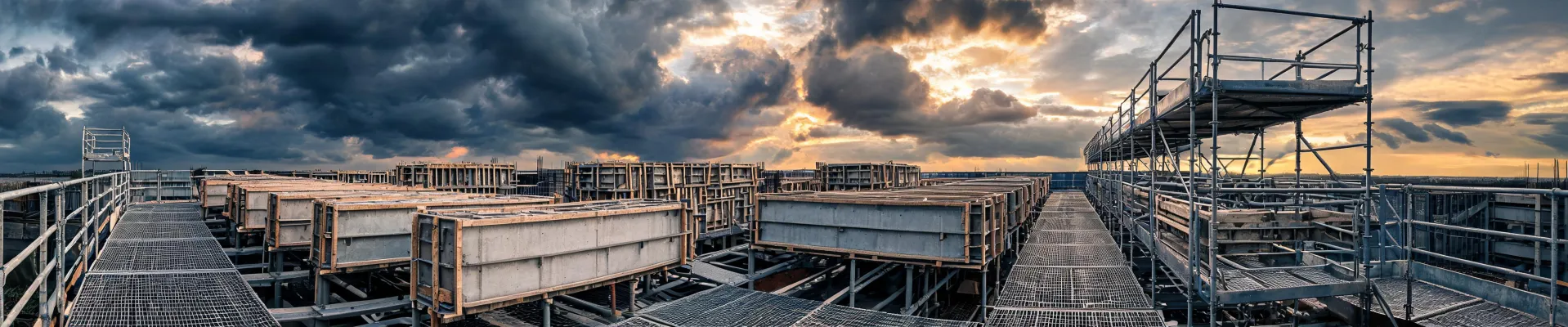
When I Inherited the Supply Closet
I became the de facto procurement person for our construction supply company in 2021. Not because I had a background in formwork—I was the office administrator who knew how to file invoices and kept the supply closet from turning into a black hole. (Should mention: nobody else wanted the job.)
For about eighteen months, that was fine. I ordered paper, sure. I ordered signage. I ordered enough coffee to float a small office. Then our biggest general contractor client announced a 72,000-square-foot concrete pour on a mixed-use development, and suddenly I was being asked to source a full run of formwork panels, shoring equipment, and scaffolding—all within three weeks.
I still remember the sales manager's exact words: "You've got a good relationship with some distributors, right? Just get us a scaffold catalog and some MEVA formwork and we can figure out the rest."
Reader, I had no idea what a MEVA formwork system even looked like. I had to Google it during a meeting with the client.
Comparing Catalogs When I Had No Idea What to Compare
The first thing I learned: a scaffolding catalog is not a catalog in the sense that you and I think of a catalog. Some of them are beautifully produced PDFs with 3D renders and callout numbers. Others are twenty-page scans of technical specifications with footnotes in German. I got both kinds.
I probably talked to eight or nine distributors over the first ten days. My process was, in retrospect, embarrassingly naïve—I basically ranked them by how clean their product photos looked and how quickly they responded to emails. (I'd also checked whether they could provide a proper invoice, because I'd already been burned once by a handwritten receipt that finance flatly rejected. That one cost me $2,400 out of my own department budget, and I'm still slightly bitter about it.)
The bid that looked best on paper came in around $47,000 total, roughly 12% under the next-closest offer. It included a full set of wall formwork, some shoring towers, a baker scaffold line I'd never heard of, and what the rep called "complete accessory coverage." I sent it to the client's project manager, he signed off, and I cut the purchase order the same afternoon.
That was my first mistake.
What Actually Showing Up on Site Looks Like
Delivery #1 arrived four days late. Delivery #2 arrived on time but with thirty-two formwork panels that had visible edge damage—not enough to fail a structural test, but enough that our installing crew pushed back and demanded replacements. Delivery #3 arrived with the right shoring frames but the wrong accessories, and the distributor told me the correct ones were "backordered through next quarter."
Meanwhile, the site supervisor was calling me twice a day. The client's project manager was calling me once a day, but more ominously. Construction schedules don't care that the distributor is having a rough month.
Honestly, I'm not sure why that first distributor fumbled so badly. My best guess is that they'd quoted us on inventory they didn't actually control—they were reselling from two or three upstream suppliers and hoping the timing would work out. But this is just a guess. If someone with deeper supply chain visibility has insight, I'd love to hear it.
The surprise wasn't the late delivery. Late deliveries are sadly normal. The surprise was that the other parts of the job—the ones that required MEVA Imperial panels and a proper shoring system—went flawlessly, because I'd given those to a different distributor on the same bid round.
The Pivot Nobody Warned Me About
About halfway through the pour schedule, I called MEVA directly—not as a customer, but just to ask what a distributor should be able to guarantee on their formwork systems. I got transferred three times and ended up talking to a regional technical manager who spent forty minutes walking me through what to look for in a catalog: cross-sectional load ratings, panel deflection tolerances under fresh concrete pressure, compatibility between shoring frames and formwork ties, and the difference between "accessory coverage" and "accessory availability."
That was when I understood what I'd been missing. I'd been buying a product. I should have been buying a system.
There's something satisfying about that moment of clarity. After weeks of firefighting, I finally realized that the distributors who quoted me $52K and $55K weren't overpricing—they were including things I didn't know were supposed to be included. Load documentation. On-site assembly support for the first pour. Replacement-part guarantees tied to specific project timelines.
I renegotiated the second half of the job with the distributor who'd actually been competent on the MEVA panels. Final cost: about $11,000 more than my original quote. But we avoided two weeks of schedule penalties, which would have run $42,000.
I should add that the client had no idea any of this had happened. From their side, the project went smoothly. That's the goal, I guess.
What I Actually Do Now (And What I Wish I'd Known)
These days, when I evaluate a shoring systems distributor or a scaffolding catalog, I have a short list I run through before I even ask for pricing:
- Do they sell a system or a stack of products? If the formwork, shoring, and scaffolding come from three unconnected supply chains, that's a warning sign. MEVA's strength—and the reason I now default to them for major pours—is that their formwork, shoring, and scaffolding actually interface with each other. Compatibility matters more than unit price.
- Can they document load ratings and deflection tolerances per panel? If a distributor can't hand you a proper technical data sheet within 24 hours, they don't control the product.
- Who handles the first pour? A distributor that won't send a technician to the first concrete placement is not a distributor. They're a reseller.
- What does your replacement pipeline look like during our project window? This one question eliminated 60% of the vendors I talked to on the second round.
My experience is based on roughly 40 mid-scale commercial pours across the last three years. If you're sourcing for infrastructure-scale or specialty architectural work, your evaluation criteria are probably different—and I won't pretend to know what they should be.
The client from that first project is still with us. They've given us four more jobs since then. Their project manager told me last year that our formwork finish is "consistently cleaner" than what they get from other suppliers, which I think is his polite way of saying the panels don't leak, the ties don't pull, and the walls come out straight.
The upfront cost difference between a real formwork system and a collection of parts is real. But that $11,000 I "lost" on the first project bought me a reputation that's now worth far more than the discount I was chasing. When I switched our sourcing standard from price-first to system-first, our repeat rate from general contractors went up by about 18% year over year.
That's my whole case for treating formwork and shoring sourcing the way you'd treat any other brand-defining decision. The panels arrive on day one. The reputation stays for years.